What Makes Gonstead Different | Chiropractor - O'Fallon, MO
If you have been around our office for very long, you have probably heard us say three words:
Specific. Thorough. Gonstead.
They aren't a tagline. They describe the way we approach chiropractic care at Rise Family Chiropractic.
One of the most common misconceptions about chiropractic is that every chiropractor evaluates the spine the same way and performs essentially the same type of adjustment. In reality, chiropractic includes a number of different techniques and systems, each with its own approach to examination and care.
At Rise, we practice the Gonstead System, a method of chiropractic developed by Dr. Clarence S. Gonstead and built around a central idea that has shaped the way I practice:
Before deciding where or how to adjust, gather as much useful information as possible.
That distinction matters.
Gonstead isn't a particular way of performing an adjustment. It's an entire system for analyzing the spine, interpreting findings, and determining when and where a specific chiropractic adjustment may be appropriate.
Specificity Comes Before the Adjustment
When someone comes into our office because their lower back hurts, their neck feels stiff, or they're experiencing another concern, it would be easy to focus entirely on the area they point to.
But a symptom tells us what you're experiencing. It doesn't automatically tell us everything we need to know about what's contributing to it.
That's one reason the Gonstead approach places so much emphasis on examination. The goal isn't to find as many places as possible to adjust. In fact, it's almost the opposite.
We want to gather enough information to be as specific as possible.
The Gonstead Clinical Studies Society describes five major components traditionally used in Gonstead spinal analysis: visualization, instrumentation, static palpation, motion palpation, and X-ray analysis when utilized as part of the patient's clinical evaluation.
Those components aren't intended to exist independently. The value of the system is in comparing the information they provide.
Think about it like putting together a puzzle. One piece may be interesting, but you wouldn't want to decide what the entire picture looks like based on that piece alone.
The same principle applies here.
We Don't Base Everything on One Finding
This is one of the aspects of Gonstead that I appreciate most as a doctor.
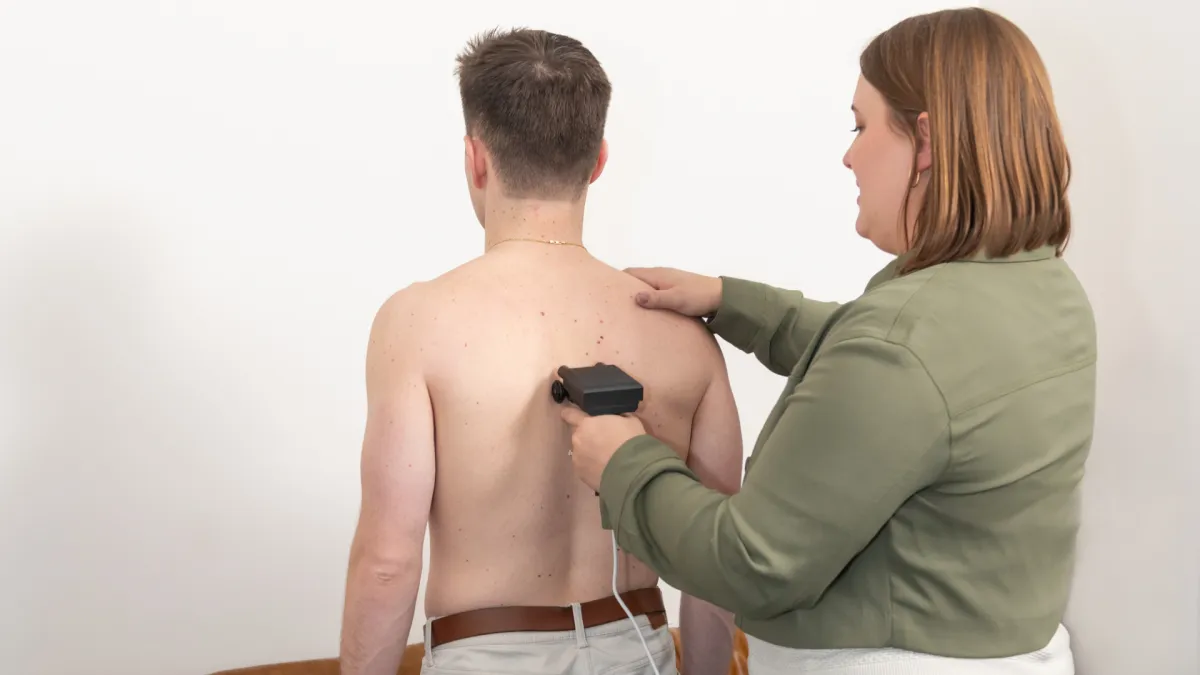
During an evaluation, we may look at how someone stands and moves. We may feel how individual areas of the spine move. We assess the tissues surrounding the spine and look for findings such as tenderness, swelling, or changes in texture. Gonstead chiropractors also use instrumentation to evaluate differences in temperature along the spine.
When clinically appropriate and indicated for a patient's individual case, imaging may provide additional structural information. Imaging decisions should always consider the patient's history, examination findings, clinical indications, and the information needed to guide appropriate care.
But here's the important part:
No single finding should tell the entire story.
A postural change alone doesn't necessarily mean a particular area needs to be adjusted. Tenderness alone doesn't tell us everything. A patient's symptoms alone don't tell us everything. Instead, the Gonstead System is designed around cross-referencing findings.
We're looking for patterns and asking whether the information we're gathering points us consistently toward the same area. That process is part of what we mean when we say our care is thorough.
Gonstead Isn't About Adjusting Everything
People sometimes assume that a chiropractic appointment means the entire spine will be adjusted from top to bottom. That isn't how Gonstead doctors approach care.
One of the defining characteristics of Gonstead is its emphasis on identifying and addressing specific areas rather than automatically manipulating multiple spinal regions.
The Gonstead Clinical Studies Society's overview of the technique specifically describes this emphasis on determining which spinal levels are targeted and how the adjustment is delivered.
In practical terms, that means your visit may not look exactly like someone else's.
Two people can walk into Rise complaining about what sounds like the same problem and have different examination findings. Their histories may be different. Their movement may be different. The areas requiring our attention may be different.
So their care may be different, too.
The symptom doesn't determine the adjustment. The individual evaluation does.
That's an important distinction.
The Adjustment Itself Is Specific, Too
The analysis is only one part of Gonstead. The adjustment is another.
Once we have determined that a chiropractic adjustment is appropriate and identified the area we're addressing, the goal is to deliver that adjustment as specifically as possible.
That includes considering the patient's anatomy, positioning, the spinal region being addressed, and the direction in which the adjustment is delivered.
This is also why you may notice different tables and equipment in a Gonstead office.
The official Gonstead Doctor Protocol identifies equipment such as the cervical chair, knee-chest table, pelvic bench, and Hy-Lo or slot table as part of traditional Gonstead practice.
These aren't there simply because they look different from what you might expect in a chiropractic office. Different positions and equipment give the doctor options for addressing different areas of the spine while maintaining the specificity central to the technique.
For me, the important question isn't:
"How many areas can I adjust today?"
It's:
"Based on today's evaluation, what actually needs my attention?"
It's a System, Not Just a Technique
This may be the biggest difference I want patients to understand.
When people hear the word technique, they often think it refers only to the physical adjustment itself.
Gonstead is broader than that.
Dr. Clarence Gonstead developed and refined an interconnected approach to evaluating and adjusting the spine. His work included advancements in spinal analysis, instrumentation, radiographic analysis, adjusting equipment, and adjustment procedures. The Gonstead Clinical Studies Society's history of Dr. Gonstead documents many of those contributions and how his method developed over decades of practice.
That systematic approach is what attracted me to Gonstead. I don't want to guess. I don't want to choose an adjustment just because an area hurts. And I don't believe every patient who walks through our doors should receive an identical visit.
I want a process that requires me to look, assess, compare, think, and then act.
Gonstead gives me that framework.
What Does This Mean for You as a Patient?
Ultimately, most patients aren't interested in becoming experts in chiropractic technique. You don't need to memorize the components of a Gonstead analysis or understand every piece of equipment in our office.
But you should understand why your doctor is doing what they're doing.
When we evaluate you, we're gathering information that helps us make clinical decisions about your care. When we check an area instead of immediately adjusting it, there's a reason. When your adjustment looks different from your spouse's, child's, or friend's adjustment, there's a reason. When we don't adjust an area you expected us to adjust, there's a reason for that too.
Specific care requires us to treat the person standing in front of us as an individual.
Why We Chose Gonstead at Rise
At the end of the day, there are many ways to practice chiropractic.
We chose Gonstead because its emphasis on specificity and thorough analysis aligns with the kind of doctors we want to be.
We want to know your history, understand what you're experiencing, examine rather than assume, compare findings rather than rely on one piece of information...
And when an adjustment is appropriate, we want it to be intentional and specific to what we've found.
That's what Specific. Thorough. Gonstead. means to us.
If you've been wondering what makes Gonstead chiropractic different, or you're looking for a Gonstead chiropractor in O'Fallon, Missouri, we'd be happy to help you understand our approach and determine whether Rise Family Chiropractic may be a good fit for you.


