Why We Don’t Wait Until Something Hurts | Chiropractor - O'Fallon, MO
One of the most common things I hear from people is some version of, “But I feel fine.”
And I understand why.
For most of our lives, we are taught to think about health reactively. If something hurts, we address it. If we feel sick, we make an appointment. If we can still work, exercise, take care of our families, and get through the day without much discomfort, we assume everything must be functioning exactly as it should.
But health is rarely that simple.
At Rise Family Chiropractic in O’Fallon, Missouri, one of the ideas we spend a lot of time helping people understand is that pain is important, but it is not a complete measurement of health or function. The human body is remarkably adaptable. It can change the way we move, recruit different muscles, alter movement patterns, and compensate for physical demands long before those changes become uncomfortable enough to get our attention.
That is why we don’t believe the best time to think about your health is always the moment something begins to hurt.
Pain Has an Important Job
Before we go any further, I want to make something clear: pain is not the enemy.
Pain is an incredibly sophisticated protective mechanism. According to the National Library of Medicine’s overview of pain physiology, nociception involves detecting potentially harmful stimuli and transmitting that information through the nervous system, while the experience of pain involves additional processing within the brain. These systems serve an important adaptive role in helping protect us from potential tissue damage.
If you touch a hot stove, pain tells you to move your hand. If you sprain an ankle, discomfort may encourage you to protect it while the injured tissue recovers. Pain can also be an important reason to seek medical evaluation when something is wrong.
The problem comes when we begin treating the absence of pain as proof that everything is functioning perfectly.
Those two things are not necessarily the same.
Think about how many health decisions we already make proactively. We brush our teeth before we have a cavity. We exercise before cardiovascular disease develops. We prioritize nutritious foods before a blood test tells us something is wrong. We take our vehicles in for routine maintenance instead of waiting for smoke to start coming from under the hood.
Yet when it comes to our musculoskeletal health, many people have been conditioned to wait for pain.
Your Body Is Remarkably Good at Adapting
Your body is constantly responding to what you ask it to do.
If you spend eight hours sitting at a desk, your body adapts. If you repeatedly carry a toddler on the same hip, your body adapts. If you work a physically demanding job, spend hours driving, train for a sport, look down at a phone throughout the day, or sleep in the same position every night, your body continually makes adjustments that allow you to keep functioning.
Most of those adaptations happen without you consciously noticing them.
That is one reason someone can develop changes in movement or posture without immediately experiencing pain. As we discussed in “Why Good Posture Is About More Than Standing Up Straight,” posture itself is dynamic. Your brain, nervous system, muscles, and joints are continually working together to help you remain balanced and move through your environment.
Sometimes those adaptations work extremely well.
Until they don’t.
A person may unconsciously shift more weight onto one side when standing. Certain muscles may begin doing more work while others contribute less. Someone may gradually lose mobility in one area and compensate by moving more through another.
The body can accommodate a tremendous amount of change, which is one of the things that makes it so remarkable. But being able to compensate does not necessarily mean that the compensation is ideal indefinitely.
Symptoms Don’t Always Tell the Entire Story
This is also why healthcare becomes more complicated when we reduce everything to symptoms.
Symptoms matter. They provide useful information and should never simply be ignored. But they are one part of a much larger clinical picture.
Even pain itself is more complex than many people realize.
Cleveland Clinic explains that chronic pain can involve changes in the way the central nervous system processes sensory information. In some circumstances, the nervous system can become increasingly sensitive, meaning the relationship between tissue condition and the amount of pain someone experiences is not always straightforward.
This is important because it challenges two common assumptions: “If I hurt, something must be severely damaged,” and “If I don’t hurt, everything must be perfect.”
Neither statement gives us enough information on its own.
As doctors, our job is to look at the whole person rather than making conclusions based on a single symptom.
This Is Why Examination Matters
This philosophy is one of the reasons I appreciate the specificity of the Gonstead System.
At Rise Family Chiropractic, we don’t want to make decisions simply because someone points to an area and says, “It hurts here.”
A thorough examination gives us considerably more information.
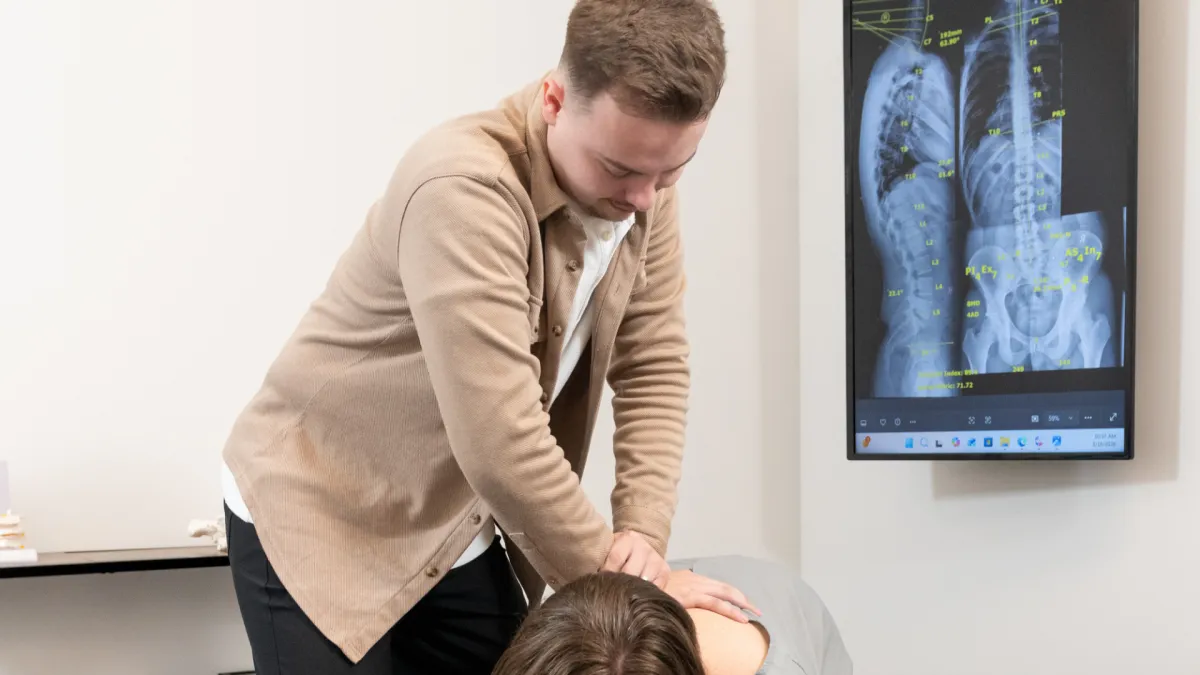
The Gonstead Clinical Studies Society describes five components used within a Gonstead spinal analysis: visualization, instrumentation, static palpation, motion palpation, and X-ray analysis when clinically appropriate. Each provides a different piece of information that can be considered alongside the patient’s history and clinical presentation.
That comprehensive approach matters because where you feel something and what we find clinically are not always identical.
It is also why individualized care matters so much. Two people can walk into our O’Fallon chiropractic office describing similar discomfort and have very different histories, examination findings, lifestyles, and needs.
We aren’t interested in guessing.
We want to understand what your body is telling us.
Reactive Care Has Its Place
There is absolutely a time and place for reactive healthcare.
If you are injured, suddenly develop significant pain, experience neurological symptoms, or notice another concerning change in your health, seeking appropriate medical evaluation is important. Chiropractic care should never be used as a reason to ignore symptoms that warrant evaluation by another healthcare professional.
But proactive health asks a different question.
Instead of only asking, “How do I make this symptom go away?” it asks, “What can I do consistently to support my health and function over time?”
That distinction applies far beyond chiropractic.
Regular movement matters before we become stiff. Sleep matters before exhaustion catches up with us. Nutrition matters before laboratory values change. Strength matters before everyday activities become difficult.
The same principle can influence how we think about spinal health and movement.
Feeling Better and Functioning Better Aren’t Always the Same Goal
One of the easiest mistakes to make is assuming that the moment discomfort disappears, there is nothing else worth paying attention to.
Pain relief is valuable. Nobody wants to hurt.
But if our entire definition of health becomes “nothing hurts today,” we may be setting the bar too low.
Consider someone who has spent years sitting at a computer. They may have gradually lost mobility, developed movement compensations, and become less physically active without experiencing significant pain. Another person may have stopped doing certain activities because they make their back uncomfortable but insist their back “doesn’t really bother them.”
We adapt our lives surprisingly easily.
Sometimes we stop noticing how much we have adapted.
This is similar to what we explored in “The Truth About ‘Getting Older’—What’s Normal and What’s Not?” Not every change in movement, energy, or physical ability should automatically be dismissed as an unavoidable consequence of age. Paying attention earlier gives us an opportunity to ask better questions.
Consistency Matters More Than Crisis Management
At Rise, we talk frequently about consistency because health is rarely built through one dramatic decision.
It is usually built through ordinary choices repeated over time.
You don't become physically strong after one workout. One nutritious meal doesn't transform your health. One great night of sleep cannot compensate for months of exhaustion.
Similarly, taking care of your spine and nervous system is not something we believe should only cross your mind during a crisis.
That does not mean everyone needs the same chiropractic schedule indefinitely. Your recommendations should be based on your individual examination findings, health history, progress, and goals.
It means we want people to think beyond the emergency-only model of health.
The goal is not dependence on care.
The goal is greater awareness of your body and intentional stewardship of your health.
Your Nervous System Is Always Paying Attention
One reason this conversation matters so much in chiropractic is the role of the nervous system.
Your nervous system constantly receives information about what is happening both inside and outside your body. It helps coordinate movement, muscle activity, balance, sensory information, and countless processes you never consciously think about.
Pain is one way your nervous system communicates with you, but it is certainly not the only way we evaluate how someone is functioning.
This is why our approach at Rise is neurologically focused and examination driven. We aren't interested in chasing every symptom around the body or assuming every health complaint comes from the spine.
We are interested in identifying what our examination actually shows and being specific about the care we provide.
That philosophy is central to the Gonstead approach. The Gonstead Clinical Studies Society’s overview of the technique emphasizes using multiple examination methods together rather than relying on a single finding when evaluating a patient.
Don't Wait for Your Body to Scream Before You Listen
I think this is ultimately the message I want people to understand.
You do not need to become afraid of every ache, analyze every movement, or assume something is wrong simply because your body isn't perfect.
That isn't health either.
Instead, learn to pay attention.
Notice when your mobility changes. Notice when you consistently feel stiff after sitting. Pay attention when you stop doing activities you used to enjoy because they have become uncomfortable. Consider the demands your job, hobbies, exercise routine, parenting responsibilities, and daily habits place on your body.
And don't assume the only time your health deserves attention is when your body finally forces you to stop.
Your body is remarkably adaptable, and that adaptability allows you to do incredible things. Supporting it proactively is not about chasing perfection or preventing every possible problem.
It's about giving yourself the best opportunity to continue moving, working, playing, parenting, and enjoying your life well.
At Rise Family Chiropractic in O'Fallon, Missouri, our goal is to help individuals and families better understand their bodies through thorough Gonstead chiropractic examinations and individualized care. If it has been a while since you've been checked, you don't have to wait until something hurts to start paying attention to your health.
The best time to listen to your body is before it has to get loud enough to demand your attention.
COME SEE US


